Neural Networks Explained: How Machines Learn From Examples
2026-04-26 · Manuel Spörer
It does not begin with consciousness. It begins with an error.
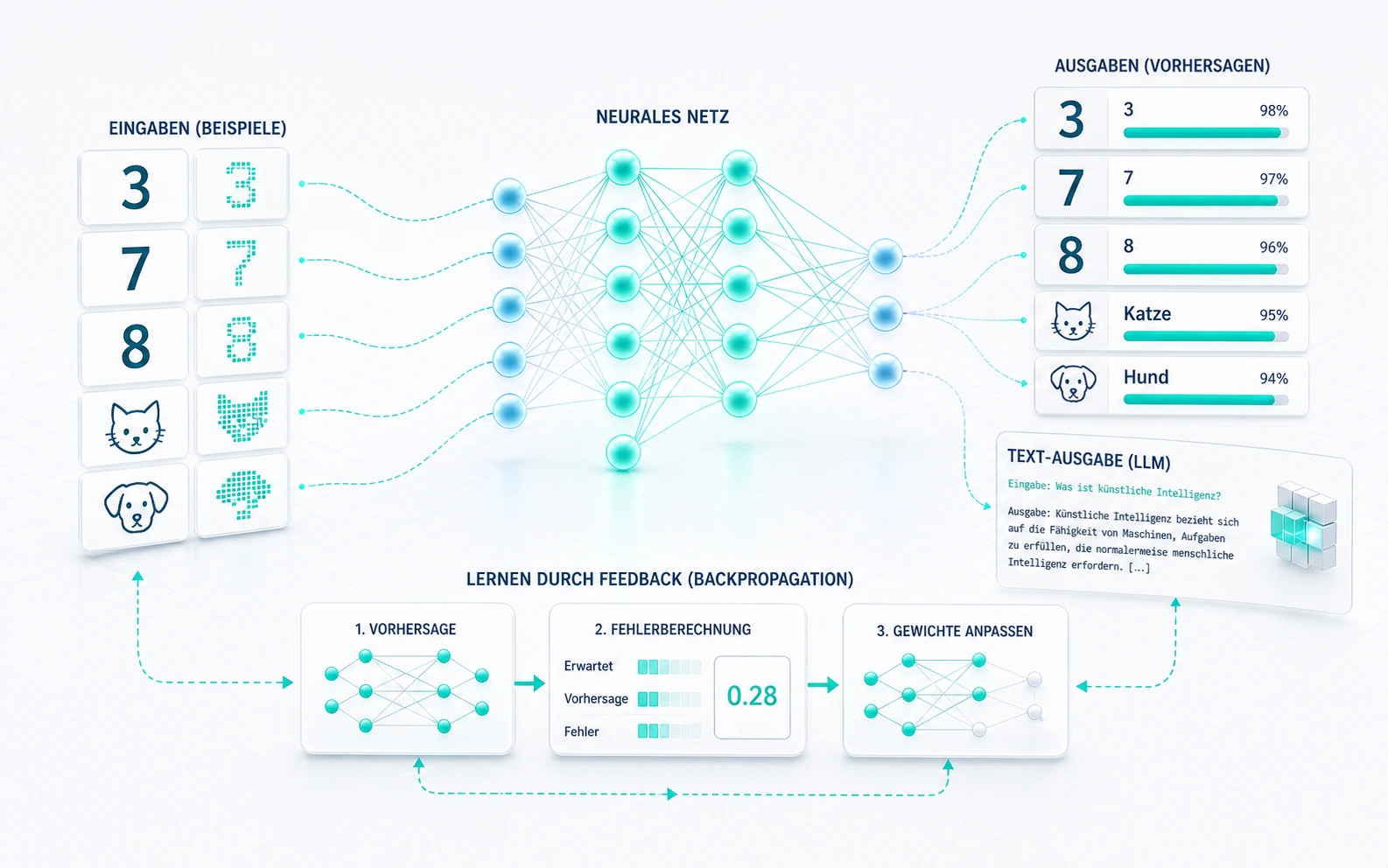
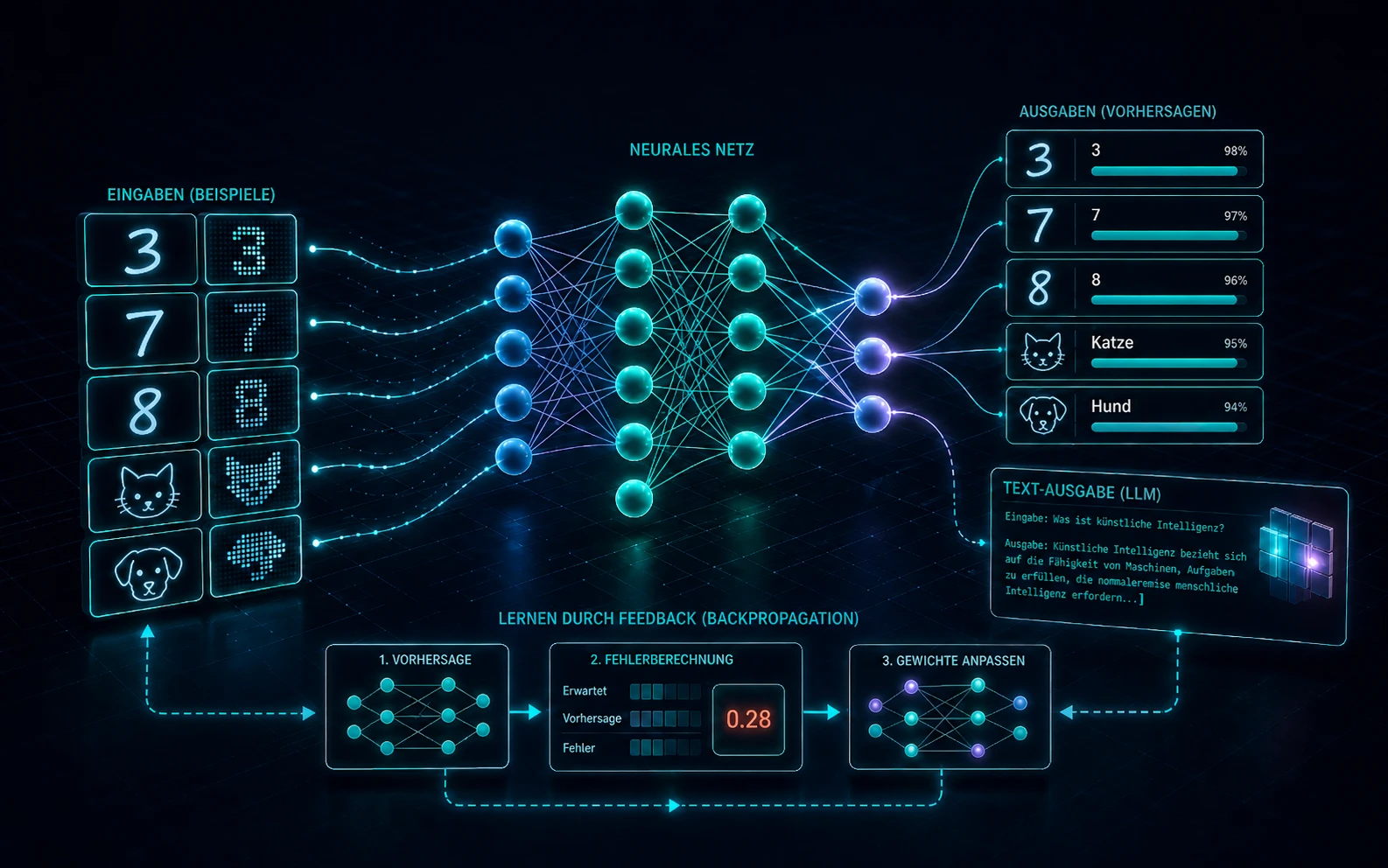
A machine is supposed to recognize handwritten digits. It sees an image, says "8" even though the correct answer is "3," and receives feedback: wrong. On the next attempt, it changes tiny internal control knobs. Not much. Just enough to perhaps do a little better on the next image.
That modest loop is the core of modern AI: see an example, make a prediction, measure the error, adjust the weights. Again and again. From many small corrections, a system emerges that recognizes patterns nobody programmed by hand.
Neural networks often feel as if they appeared out of nowhere. Chatbots write text, image models generate visuals, recommendation systems sort feeds, assistants recognize speech. Underneath, however, sits a clear idea that is much older than the current AI boom: machines can learn patterns from examples instead of only executing hand-written rules [1, 3].
This article is a thematic starting point. It explains what a neural network is, how training works, why "learning" is not the same as understanding, and how this basic idea leads all the way to modern LLMs.
What Is a Neural Network?
A neural network is a mathematical model that turns inputs into outputs. An image becomes a class. The beginning of a sentence becomes a next word. A signal becomes a decision. The name points back to biological neurons, but the technical reality is more sober: numbers, weights, activation functions, and many computation steps [3, 4].
The basic idea is simple. An artificial neuron receives several inputs. Each input gets a weight. The weighted values are added together and passed through an activation function. This nonlinear activation matters because it lets neural networks learn more complex relationships than purely linear models [4].
One such neuron alone is not remarkable. Things become interesting when many neurons are connected in layers. Then a network can detect simple patterns in early layers and combine them into more complex structures in later layers.
How Do Neural Networks Learn From Examples?
The key difference from classical software lies in training. In classical programming, a human writes rules: if this happens, do that. With neural networks, you give the system examples and let it find useful internal settings itself. This idea already sits behind early learning models such as Rosenblatt's perceptron [1].
A simple example: a model is supposed to distinguish cat images from dog images. At the beginning, its weights are random. It guesses, is often wrong, and receives feedback for every image. That feedback is translated into an error value. The model then changes its weights so that the error should become smaller next time.
This is not intuition. It is optimization. The network searches through a huge space of possible settings for a configuration that produces good predictions.
Training in One Sentence
A neural network learns by comparing its outputs with the correct answers and adjusting its weights so that the error becomes smaller across many examples [2, 4].
This kind of learning is why neural networks are powerful for tasks where humans struggle to write exact rules. How do you describe every possible version of a handwritten "7"? How do you formulate a complete rule for "looks like a dog"? Such patterns are often easier to show than to program.
Why Weights Are the Model's Real Memory
Once a neural network has been trained, its "knowledge" is not stored as a list of individual examples. It is distributed across the weights. These weights determine which signals are amplified, weakened, or combined [3, 4].
That matters because it corrects a common misconception: a trained AI model is not simply a database. It does not mechanically look up which image or sentence appeared during training. It computes an output from an input based on patterns stored in its weights.
Large models can sometimes reproduce individual training items, especially when data appears repeatedly or is poorly filtered. But the basic principle is still different from a search engine. A neural network does not remember like an archive. It generalizes across examples [4, 8].
Backpropagation: How Error Moves Backward Through the Network
For a network to improve, it has to know which weights contributed to the error. This is where backpropagation comes in. In the 1980s, the method became a central building block of modern neural networks [2].
In simplified terms, it works like this: the network makes a prediction. A loss function measures how far that prediction is from the desired result. The error is then distributed backward through the layers. For every weight, the system calculates in which direction it should be changed slightly. An optimization method then updates the weights [2, 4].
Each individual step is small. The effect comes from repetition. Modern models process huge datasets, often over many training steps. Learning here is not a moment of insight, but a long chain of tiny corrections.
Why Deep Neural Networks Became So Powerful
The idea of neural networks is older than today's AI hype. Early models such as the perceptron already showed that machines could learn simple patterns from examples [1]. For a long time, however, practical impact remained limited. There was not enough data, compute, or robust training practice [3].
The breakthrough came when several developments met: large digital datasets, GPUs, better optimization methods, and architectures that made many layers trainable. This became deep learning [3, 4].
"Deep" does not mean mysterious here. It means deeply layered. A deep network can learn representations at several levels. In images, early layers may detect edges, middle layers shapes, and later layers whole objects. This idea of hierarchical representations is one of the central points behind the deep-learning breakthrough [3, 4].
Why More Layers Are Not Automatically Better
Depth only helps when training, data, and architecture fit together. A larger network can learn more, but it can also absorb more errors. It can overfit, meaning it copies training examples too closely instead of learning robust patterns. It can amplify biases in the data. And it can produce plausible outputs that are still wrong [4, 9].
That is why modern AI is not only a question of model size. Data quality, training objective, evaluation, infrastructure, and the concrete use case matter just as much.
What Neural Networks Are Good At
Neural networks are especially strong when patterns exist in large datasets. They recognize objects in images, translate text, classify signals, transcribe speech, generate code, and discover relationships in complex data. LeCun, Bengio, and Hinton describe this strength as a central reason for progress in speech, image, and signal processing [3].
Their strength is that humans do not have to define every useful feature manually. Instead, networks learn internal representations that help with the task. That is what makes them so flexible. The same basic principle can be used for images, audio, text, sensor values, or medical data [3, 4].
In practice, neural networks are tools for fuzzy, high-dimensional problems. They shine where rules are hard to formulate but enough good examples exist.
Where Neural Networks Can Fail
The same flexibility makes neural networks hard to inspect. They do not automatically provide an explanation that a human can directly verify. They may react to signals that only accidentally correlate with the real task. They may inherit biases from training data. And they may fail on inputs that look harmless to humans but sit outside the learned distribution [4, 9].
This becomes especially visible in generative models. A language model produces likely continuations. That can lead to helpful explanations, but also to convincing mistakes. Hallucinations are therefore not a small cosmetic flaw at the edge. Research on natural language generation describes hallucination as a recurring problem where generated text is not sufficiently supported by the input, context, or factual basis [7].
This does not make neural networks useless. It means they must be treated as statistical systems. The more important the decision, the more important verification, sources, measurement, and human responsibility become.
What Neural Networks Have to Do With LLMs
Large language models are a particularly visible form of neural network. Many modern LLMs are autoregressive language models: they are trained to predict the next token from context. At very large scale, this can lead to abilities such as summarization, translation, programming, explanation, and argumentation [6].
The major turning point for modern language models was the transformer architecture. It uses attention to model relationships between many positions in a text at the same time and was originally proposed as a sequence-processing architecture without recurrence or convolution as the main mechanism [5]. This lets models process contextual relationships differently from older sequence models [5].
But even with LLMs, the basic logic remains the same: inputs are translated into numbers, passed through many learned transformations, and turned back into text at the end. The chat window is only the surface. Underneath are weights, data, training, hardware, and inference systems.
That is why neural networks lead directly to the next technical questions: What hardware does local AI need? Why does memory bandwidth shape speed? And why can CUDA, drivers, and Compute Capability determine whether a model runs at all? Those infrastructure topics continue in the CUDA and hardware articles [10, 11].
Conclusion: Learning From Examples Is the Real Revolution
Neural networks matter not because they rebuild a brain. They matter because they enable a different kind of software. Instead of writing every rule, you show examples. Instead of programming behavior completely, you train parameters. Instead of building rigid decision trees, you create flexible pattern recognizers.
That is the real shift: machines can learn structures from data that humans could not cleanly describe as rules. This does not explain everything about modern AI, but it is its foundation.
Once you understand neural networks, today's AI becomes both more sober and more interesting. Less magic, more mechanics. Less myth, more craft. And that is where the better entry point begins: into LLMs, local models, GPU infrastructure, and the question of which AI systems are genuinely useful in everyday work.
Sources
[1] Frank Rosenblatt. The Perceptron: A Probabilistic Model for Information Storage and Organization in the Brain. Psychological Review, 1958. https://doi.org/10.1037/h0042519
[2] David E. Rumelhart, Geoffrey E. Hinton, Ronald J. Williams. Learning representations by back-propagating errors. Nature, 1986. https://doi.org/10.1038/323533a0
[3] Yann LeCun, Yoshua Bengio, Geoffrey Hinton. Deep learning. Nature, 2015. https://doi.org/10.1038/nature14539
[4] Ian Goodfellow, Yoshua Bengio, Aaron Courville. Deep Learning. MIT Press, 2016. https://www.deeplearningbook.org/
[5] Ashish Vaswani, Noam Shazeer, Niki Parmar et al. Attention Is All You Need. arXiv, 2017. https://arxiv.org/abs/1706.03762
[6] Tom B. Brown, Benjamin Mann, Nick Ryder et al. Language Models are Few-Shot Learners. arXiv, 2020. https://arxiv.org/abs/2005.14165
[7] Ziwei Ji, Nayeon Lee, Rita Frieske et al. Survey of Hallucination in Natural Language Generation. ACM Computing Surveys, 2023. https://doi.org/10.1145/3571730
[8] Nicholas Carlini, Florian Tramèr, Eric Wallace et al. Extracting Training Data from Large Language Models. USENIX Security, 2021. https://www.usenix.org/conference/usenixsecurity21/presentation/carlini-extracting
[9] Emily M. Bender, Timnit Gebru, Angelina McMillan-Major, Shmargaret Shmitchell. On the Dangers of Stochastic Parrots: Can Language Models Be Too Big? FAccT, 2021. https://doi.org/10.1145/3442188.3445922
[10] AI Crack Heads. CUDA, Compute Capability, and Drivers: Why New NVIDIA GPUs Suddenly Stop Working. https://ai-crack-heads.com/en/blog/cuda-compute-capability-drivers
[11] AI Crack Heads. DGX Spark vs. RTX 5090 vs. RTX PRO 6000 Blackwell: Which NVIDIA Platform Fits Which AI Workloads? https://ai-crack-heads.com/en/blog/dgx-spark-vs-rtx-blackwell-part1