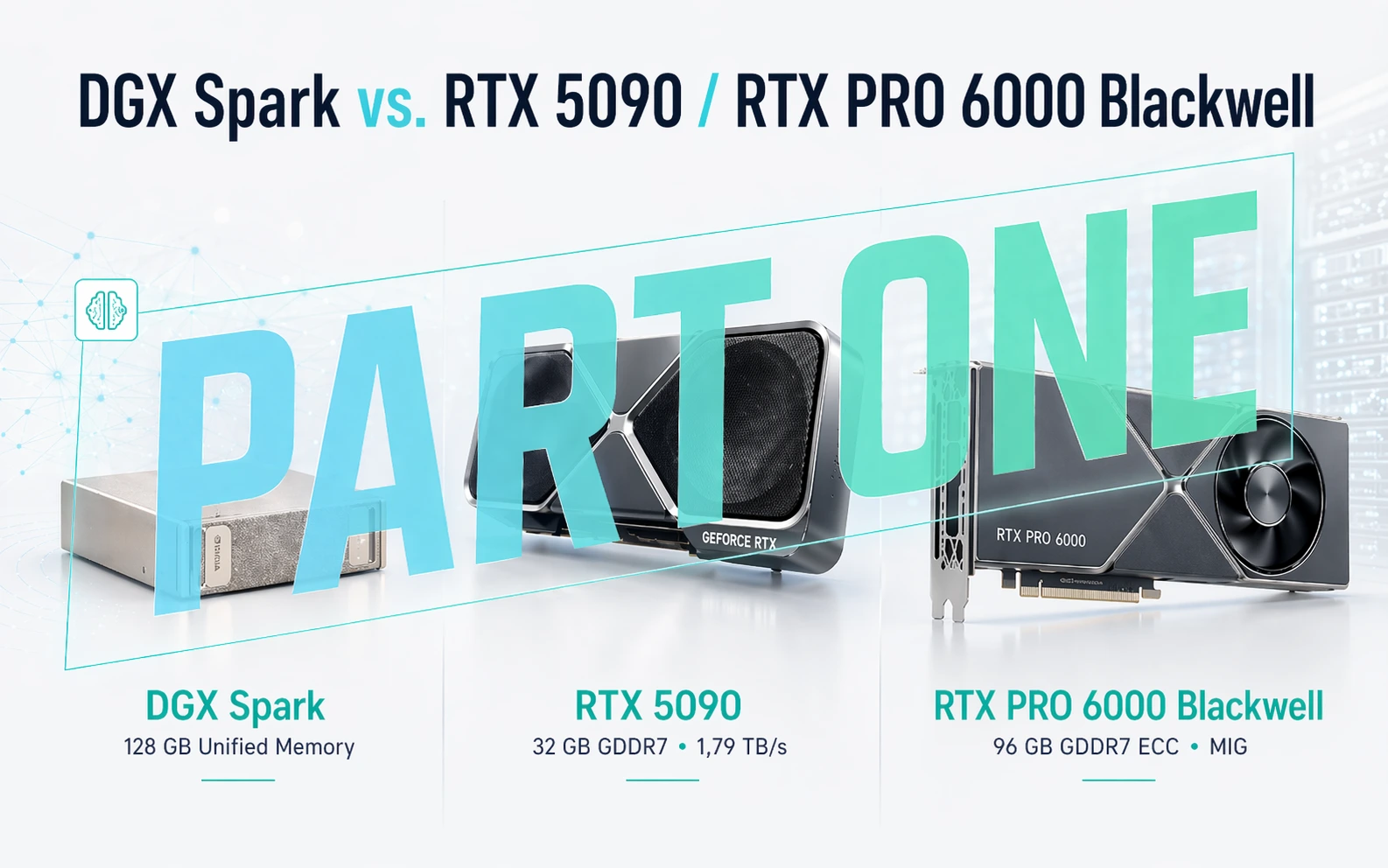
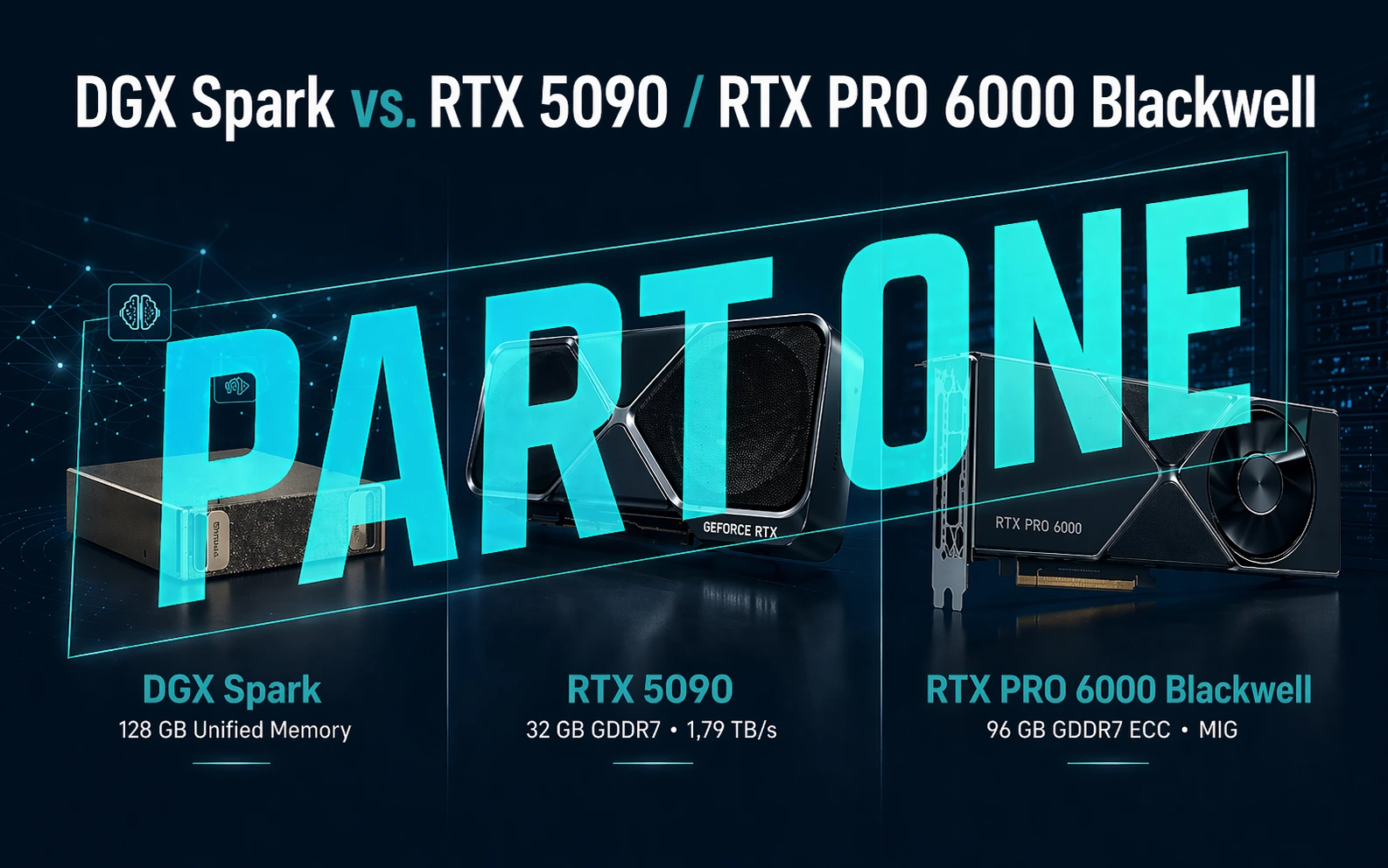
DGX Spark vs. RTX 5090 vs. RTX PRO 6000 Blackwell: Which NVIDIA Platform Fits Which AI Workloads?
2025-12-15 · Manuel Spörer
With its Blackwell generation, NVIDIA covers several distinct product classes at once: from a compact AI development system to the fastest consumer GPU to a professional workstation card with large amounts of ECC memory. That is exactly what makes comparing the DGX Spark, GeForce RTX 5090, and RTX PRO 6000 Blackwell so interesting — and, at the same time, so tricky.
Although all three products are built on Blackwell, they pursue very different goals. Anyone who focuses only on buzzwords like FP4, Tensor Cores, or TOPS quickly overlooks the decisive differences in memory architecture, bandwidth, scaling, power draw, and platform concept. This first part therefore isn't about detailed benchmarks — it's about the fundamental question: what is each product, and what was it actually built for? The consequences for real workloads like LLM inference, diffusion, Gaussian splatting, or fine-tuning will follow in Part 2.
NVIDIA DGX Spark: The Compact AI Supercomputer for Your Desk
The NVIDIA DGX Spark isn't a classic desktop GPU — it's a complete AI system in a mini form factor. NVIDIA positions the device as a "Personal AI Supercomputer" [1]. At its core sits the GB10 Grace Blackwell Superchip, which combines a Blackwell GPU with an ARM-based Grace CPU on a single SoC. Specifically, 20 CPU cores are used, split into 10× Cortex-X925 and 10× Cortex-A725. CPU and GPU communicate directly via NVLink-C2C [1, 2].
Technically, the DGX Spark stands out above all because of its memory approach. Instead of traditional VRAM, the system uses 128 GB of LPDDR5X unified memory, accessible to both CPU and GPU through a shared address space [1, 2]. On top of that, NVIDIA specifies up to 1 PetaFLOP of FP4 tensor performance with sparsity [1, 3]. The system also includes an integrated 200 GbE ConnectX-7 port, which allows two Spark systems to be linked together. NVIDIA cites a combined memory capacity of 256 GB for this cluster and positions it for models of up to roughly 405 billion parameters [1, 4]. The software base is DGX OS, an Ubuntu-based environment with the NVIDIA AI stack preinstalled [4]. NVIDIA lists a TDP of 140 watts for the SoC, with total system power draw running somewhat higher [1].
Where the DGX Spark Shines
The DGX Spark becomes attractive whenever memory size, platform consistency, and local development matter more than maximum raw compute. Its biggest advantage is that it can run models locally which already fail on many consumer GPUs simply because of memory constraints. NVIDIA talks about inference for models up to around 200 billion parameters [1, 4].
Add to that the proximity to the broader NVIDIA ecosystem. Anyone who develops locally and later wants to continue working in DGX Cloud or data-center environments benefits from a relatively seamless setup [1, 4]. That is really the core appeal of the system: it isn't so much the "fastest GPU" as it is a portable development platform for large AI models.
Independent assessments point in the same direction. In an early hands-on review, LMSYS describes the raw tensor performance as roughly sitting between an RTX 5070 and an RTX 5070 Ti, while also flagging LPDDR5X bandwidth as the limiting factor compared to discrete GPUs [3]. In practical terms: if you're after maximum speed for mid-sized local inference, a strong RTX card will often serve you better. The DGX Spark becomes interesting exactly where the memory footprint of traditional consumer cards becomes the bottleneck, or where you deliberately want a development environment close to the DGX stack [1, 3, 4].
GeForce RTX 5090: Maximum Consumer Performance for AI, Creators, and Rendering
The GeForce RTX 5090 is NVIDIA's current consumer flagship in the Blackwell generation. Officially it targets gaming and creator audiences, but in practice it is also one of the most exciting cards for local AI workloads — provided there's enough memory for the task [5, 6].
The card is based on the GB202 chip and ships with 21,760 CUDA cores, 680 fifth-generation Tensor Cores, and 170 fourth-generation RT Cores [5, 6]. For memory, NVIDIA uses 32 GB of GDDR7 on a 512-bit interface, delivering around 1.79 TB/s of bandwidth [5, 6, 7]. This is rounded out by 96 MB of L2 cache, more than the RTX 4090's 72 MB [8]. The card uses PCIe 5.0 x16, is manufactured on TSMC's 4NP process, and at 575 watts TGP sits firmly in the high-end segment [5, 6]. Particularly relevant for AI is FP4 support through the fifth-generation Tensor Cores, which makes the RTX 5090 one of the first consumer GPUs with native FP4 support [9].
Where the RTX 5090 Plays to Its Strengths
The RTX 5090 is strong anywhere high memory bandwidth and maximum raw compute make the difference. That applies to diffusion models, local image and video generation, Gaussian splatting, 3D rendering, and inference on quantized language models in the range of up to roughly 30 billion parameters [5, 6].
Memory bandwidth in particular is a key point. At around 1.79 TB/s, the RTX 5090 sits well above previous consumer generations, which matters especially for token generation in large language models [5]. In many real-world scenarios, the card is therefore not simply a gaming GPU dressed up with AI marketing, but a serious workstation for local AI applications.
The limiting factor, however, is clearly memory. 32 GB of VRAM is a lot for a consumer card, but with larger models, fine-tuning, or more demanding multimodal workloads, that budget fills up quickly. On top of that, NVIDIA dropped NVLink on the RTX 5090. Anyone looking to combine multiple cards is therefore stuck with PCIe and software stacks like DeepSpeed or Ray [10]. The platform requirements are steep too: a 575-watt card with a bulky cooler and typical three-slot form factor demands a correspondingly sized system [5, 6].
RTX PRO 6000 Blackwell: Professional Desktop GPU with 96 GB of ECC Memory
The RTX PRO 6000 Blackwell Workstation Edition is the professional expansion stage of the same architectural concept. At its core it shares the Blackwell base with the RTX 5090, but it is clearly aimed at professional desktop and enterprise scenarios. NVIDIA lists AI training, fine-tuning, scientific computing, and high-end visualization among its target areas [11, 12].
The card features 24,064 CUDA cores, slightly more than the RTX 5090 [11, 13]. The decisive difference, however, is in the memory: the RTX PRO 6000 offers 96 GB of GDDR7 with ECC on a 512-bit interface and likewise reaches around 1.79 TB/s of memory bandwidth [11, 13]. NVIDIA also cites up to 4,000 AI TOPS in FP4 with sparsity [13]. The Workstation Edition is designed for 600 watts TGP and uses PCIe 5.0 x16 [13, 14]. On top of that come professional features like MIG (Multi-Instance GPU), the ability to partition the GPU into several isolated instances — a capability missing from consumer cards like the RTX 5090 [14]. Fifth-generation Tensor Cores with FP4 and FP8 support are part of the package, as are visualization-oriented features [12]. There is also a Max-Q variant at 300 watts, which can be interesting for denser or quieter deployments [15].
Why the RTX PRO 6000 Is More Than Just a Bigger RTX 5090
The RTX PRO 6000 becomes relevant wherever an RTX 5090 either doesn't bring enough memory, enough reliability features, or enough management capability. That applies, for example, to fine-tuning of larger models, local training with bigger batch sizes, professional simulation and CAD workloads, VFX pipelines, or medical and scientific applications [11, 12, 13].
The decisive lever is the 96 GB of ECC VRAM. Compared to the RTX 5090 that is triple the memory capacity — a difference that, in practice, shifts entire classes of workloads from "not feasible" to "feasible" [11, 13]. ECC, on top of that, is not a luxury in many professional environments but a hard requirement. The same goes for MIG whenever multiple teams, users, or processes need to share a single GPU in a controlled way [14].
That makes the RTX PRO 6000 far from a card for everyone, but it is a very clear answer to the question of how much professional AI and visualization work can be handled today on a single desktop system — provided the budget, cooling, and platform are built for it.
DGX Spark vs. RTX 5090 vs. RTX PRO 6000: The Logic Behind the Comparison
Anyone comparing these three products should not mistake them for direct variants of the same thing. They solve different problems.
The DGX Spark is first and foremost a compact development platform for large models, with plenty of unified memory and a close link to the DGX stack [1, 4].
The RTX 5090 is the powerful consumer and creator card, impressive in many AI and rendering workloads thanks to raw performance and enormous bandwidth [5, 6].
The RTX PRO 6000 Blackwell is the professional desktop solution for workloads where memory capacity, ECC, management features, and professional reliability matter most [11, 12, 14].
Exactly for that reason, comparisons based purely on marketing numbers tend to mislead. Yes, all three products share the Blackwell architecture, fifth-generation Tensor Cores, and FP4 support. But in practice, other factors decide the outcome: How much memory is actually available? How high is the bandwidth? How well does the platform scale? Which software environment is intended? And what kind of workload is actually being accelerated?
The interesting question is therefore not which product is "best" — it is: which product fits the task? That's exactly what Part 2 is about, with a focus on concrete scenarios like Gaussian splatting, video diffusion, and local LLM inference.
Sources
[1] NVIDIA. Personal AI Supercomputer Powered by Blackwell — NVIDIA DGX Spark. Product page. https://www.nvidia.com/en-us/products/workstations/dgx-spark/
[2] NVIDIA. DGX Spark — US Marketplace. https://marketplace.nvidia.com/en-us/enterprise/personal-ai-supercomputers/dgx-spark/
[3] LMSYS Org. NVIDIA DGX Spark In-Depth Review: A New Standard for Local AI Inference. October 13, 2025. https://www.lmsys.org/blog/2025-10-13-nvidia-dgx-spark/
[4] NADDOD. NVIDIA DGX Spark Founders Edition — product and FAQ page. https://www.naddod.com/products/103029.html
[5] NVIDIA. GeForce RTX 5090 Graphics Cards. Product page. https://www.nvidia.com/en-us/geforce/graphics-cards/50-series/rtx-5090/
[6] NVIDIA. NVIDIA RTX Blackwell GPU Architecture (whitepaper, v1.1). https://images.nvidia.com/aem-dam/Solutions/geforce/blackwell/nvidia-rtx-blackwell-gpu-architecture.pdf
[7] Vast.ai. NVIDIA GeForce RTX 5090 Specs: Everything You Need to Know. https://vast.ai/article/nvidia-geforce-rtx-5090-specs-everything-you-need-to-know
[8] VideoCardz. NVIDIA GeForce RTX 5090 Graphics Card Specs. https://videocardz.net/nvidia-geforce-rtx-5090
[9] NVIDIA Newsroom. NVIDIA Blackwell GeForce RTX 50 Series Opens New World of AI Computer Graphics. https://nvidianews.nvidia.com/news/nvidia-blackwell-geforce-rtx-50-series-opens-new-world-of-ai-computer-graphics
[10] Fluence. NVIDIA RTX 5090 & Datacenter Choices: Do They Fit AI Cloud? (2026). https://www.fluence.network/blog/nvidia-rtx-5090/
[11] NVIDIA. RTX PRO 6000 Blackwell Workstation Edition. Product page. https://www.nvidia.com/en-us/products/workstations/professional-desktop-gpus/rtx-pro-6000/
[12] NVIDIA. RTX PRO 6000 Blackwell Series. Family overview. https://www.nvidia.com/en-us/products/workstations/professional-desktop-gpus/rtx-pro-6000-family/
[13] IT Creations. NVIDIA RTX PRO 6000 Blackwell Workstation Edition — spec sheet. https://www.itcreations.com/nvidia-gpu/nvidia-rtx-pro-6000-blackwell-workstation-edition
[14] NVIDIA. RTX PRO 6000 Blackwell Workstation Edition — datasheet (PDF). https://www.nvidia.com/content/dam/en-zz/Solutions/data-center/rtx-pro-6000-blackwell-workstation-edition/workstation-blackwell-rtx-pro-6000-workstation-edition-nvidia-us-3519208-web.pdf
[15] Central Computer. NVIDIA RTX Pro 6000 Blackwell Max-Q Edition — spec sheet. https://www.centralcomputer.com/nvidia-rtx-pro-6000-96gb-blackwell-max-q-edition-gddr7-24-064-cuda-cores-pci-express-5-0-x16-600w-blackwell-workstation.html