Why We Need Open Weight Models — and Where Local Inference Actually Stands, October 2026
2026-10-21 · Julian Weber
Every second week somebody asks me: "Why would I run a model on my own hardware when Claude is one URL away?"
In 2023–2024 the question answered itself: use the API. In 2026 my own logs answer it the other way. Over the last 28 days, 85% of the tokens my agents processed ran on open-weight models on my two boxes at home — mostly Qwen3.8 Flash Next and Qwen3.8-27B, often with several agents working in parallel. Claude got the other 15%. (All tracked via agentsview)
That's no accident. When I bought my Strix Halo a little over a year ago, I set myself a quest: local models first, closed APIs only where local can't do the job. A year later it's not a hobby setting any more. It's how I work. The short version: open weights stopped being the consolation prize, self-hosting is not automatically cheaper, and for my own work — and for any workload where the data cannot leave — local is now the default, not the compromise.
First, the part people are missing: open weights stopped being the consolation prize
Look at one week this month.
On October 15 Meta released the weights for Muse Spark Open — 816B parameters, ~42B active per token, natively multimodal, and currently top of the open-weight leaderboards. The next day, Reflection AI put out Beam, StepFun released Step 5 Preview, NVIDIA shipped Nemotron 3.5 Super VL, and DeepSeek updated V4.1 Flash. Five open-weight releases. Three days. And Mistral Large 4 — a trillion parameters, ~52B active, Europe's first open-weight model that size — drops its weights on October 31.
Roughly 22 open-weight models shipped in October 2026 alone, from phone-sized to data-centre-sized. That is not a trickle of leftovers from the closed labs. That is a market.
The capability curve changed shape somewhere in 2025 and hasn't gone back. In April I logged the Artificial Analysis intelligence index for the models I care about: GPT-5.5 at 60, Claude Opus 4.7 and Gemini 3.1 Pro at 57, the best open-weight model at 54. Since then the index has been re-based, and anyone comparing scores across index versions is lying to you. But Artificial Analysis re-scores old models on every new version, so the current one (v4.3.2) puts April's flagships and the two models I run all day on the same scale. Its evaluations include Terminal-Bench 4.0, the agentic terminal benchmark closest to my coding and DevOps work:
| Model | Released | Runs on | AA Intelligence Index v4.3.2 |
|---|---|---|---|
| Claude Opus 5.5 (max) | Sep 2026 | API | 58 |
| Claude Opus 4.7 (max) | Apr 2026 | API | 41 (AA estimate) |
| Qwen3.8 Flash Next | Aug 2026 | my desk | 40 |
| GPT-5.5 (xhigh) | Apr 2026 | API | 38 |
| Qwen3.8-27B (xhigh) | Aug 2026 | my desk | 34 |
| Gemini 3.1 Pro Preview | Feb 2026 | API | 30 |
The frontier has moved on: Opus 5.5 sits 18 points above anything I run locally. But the model on my desk now beats two of April's three flagships and is within a point of the third. Six months ago that level of intelligence was an API at $10–11 per million tokens. Today it's a file. That lag of roughly half a year is the real shape of the curve.
Most of that fire comes from the east: DeepSeek, Moonshot, Alibaba, Xiaomi, Z.ai — with Meta occasionally rejoining, and Aleph Alpha shipping Kolibri on October 5, an Apache-2.0 German-English 78B model with ~3.5B active parameters, built explicitly for data that must stay on your own servers. When someone tells you "open weights is a given", remember that Meta's paid Muse Spark 1.1 in July broke with its own open-weight history. Availability of weights is not a law of nature. It's a business decision made by a lab, every single time, without asking you.
That, right there, is the argument.
Why we need them — the four reasons that actually hold up
1. Nobody else's terms decide whether your system works
A closed API can be deprecated by your competitor, repriced next quarter, rate-limited during your busiest hour, or tied to new terms you must accept with version 3.2 of the SDK. Open weights are a file. You download it, you pin the checksum, it still works in 2031.
Model deprecations already break production pipelines. When the model is weights-on-disk, your upgrade schedule is your decision, made in your maintenance window. For anyone selling a service with AI on the critical path, that difference is not philosophical, it's contractual.
2. Data sovereignty is a feature you cannot buy with an add-on
For my customers — mostly SMEs in Saarland and Luxembourg, plus a few people subject to secrecy obligations — the interesting question is never "which model scores highest". It is: which parties appear in the path of my data?
Run a hosted model and your privacy documentation needs the provider, the sub-processors, the transfer mechanism, and a data processing agreement you cannot audit without the provider. Run a model on your own box and the party list is: you. That removes two of the heaviest workstreams of a cloud DPIA — cross-border transfers and sub-processor sprawl — which is a genuine Article 25 privacy-by-design win.
Precision matters here, because a lot of people sell the wrong version of this argument: neither GDPR nor the EU AI Act requires you to run AI on-premise. Neither text names a deployment model. Self-hosting does not change which obligations apply to you — an HR screening tool carries the same duties under the Act whether it answers from a desk or from a vendor's API in another jurisdiction.
What self-hosting changes is your ability to demonstrate compliance. You own the logs. You pin the exact model version your documentation describes. You answer an auditor's question without opening a support ticket. That's real. It is not an exemption.
There's a second part I only understood once I started logging and monitoring what my agents actually do. An agent sees everything it touches: the .env file it reads to debug a service, the API key in a config, the customer email it summarises, the HR document it sorts. My own session archive proves it. The secret scanner over my agent transcripts has flagged 17 credentials across 8 sessions this year — Anthropic, Hugging Face, Google and GitHub tokens. On a hosted model, every one of those travels through the provider's request path and, depending on its retention policy, into its logs. For business work with personal data, client files or anything under secrecy, that isn't a privacy footnote. It's a security incident waiting for a retention policy. On a local model, the transcript never leaves the building.
3. You can look inside it
You cannot read GPT's weights. You can read Llama's.
For regulated work, that difference is load-bearing. If a customer's lawyer asks why the system rejected this application, "the model said so" is not an answer. You can inspect, log, and reproduce behaviour from a model you own; you can fine-tune it on your own documents without sending them anywhere; you can distil it into a 3B router that costs 1/50th per token.
4. The ecosystem argument, which is boring and true
When weights are downloadable, people fine-tune them, integrate them into products, teach them, optimise hardware around them, and build expertise that outlives any single vendor. When they aren't, all of that capability concentrates in a handful of providers. That's not an argument for open over closed. It's an argument for both existing. I'll take it: I want one supplier who cannot be bought by someone else, and I want three who can.
The uncomfortable part: no, this is not cheaper
I'd rather disappoint you here than sell you a homelab.
An API bills you per token. A GPU bills you per hour, whether it's working or not. Self-hosting pays off only if you keep the GPU busy — and most companies can't.
The 2026 break-even analyses all land in the same place. Rent an H100 at roughly $3.50 per GPU-hour, set it against a DeepSeek-class model priced around $3.50 per million output tokens, and you need on the order of a million output tokens per hour before self-hosting wins. A 27–70B open model against a mid-tier frontier API breaks even around 10–15 million tokens per day. Below that line you are paying for an idle GPU, and idle GPUs are the most expensive way to run AI anyone has invented.
You will be below that line more often than you think. A cluster serving a company from 09:00 to 18:00 Monday–Friday is live 45 of 168 hours a week — 27%. Inside that window, a peak-to-mean ratio of three-to-one is ordinary for an internal tool, and you size for the peak or you drop requests at 11am. Fold both in and the arithmetic inverts, which is exactly what all of those analyses find.
My own lab is where it flips back, and the reason is agents. A person typing into a chat window leaves the GPU idle most of the hour. Agents don't: this month I had up to six running at the same time. That fills exactly the hours a company cluster wastes. If your workload is agentic and the hardware is already on your desk, the utilisation argument looks very different.
If cost is the goal, the lever isn't hardware, it's routing. RouteLLM-style per-task routing has been reported to cut costs by up to ~3.7× while keeping 95% of quality, and about 37% of enterprises now run five or more models. Cheap answers to easy questions beat expensive hardware, always.
So the honest pitch is: open weights win on sovereignty, control, and permanence. Cost is the exception, not the rule. If you're buying this for the price tag, you're buying the wrong thing.
What local inference actually looks like in October 2026
Our GPUs didn't get faster. The architectures got sparse and the hardware got a lot of memory.
MoE made local frontier-class inference possible
Mixture-of-Experts means a model with 300B+ total parameters activates only a handful of billion per token. On a memory-bandwidth-bound box, that is the entire game:
| Model type | Measured on the same hardware |
|---|---|
| Qwen3-30B-A3B (MoE) | ~89 tok/s |
| Qwen3-32B (dense, similar quality tier) | ~10.7 tok/s |
8.3× faster, on the same machine, for the same task. A 27B dense model at 4-bit needs ~16–18 GB; a trillion-parameter MoE is "open" in the licence, but not "local" in the sense of running on your desk. Read the active parameters, not the headline count.
The hardware: 128 GB on your desk, for less than a used car
| NVIDIA DGX Spark (GB10) | AMD Strix Halo (Ryzen AI Max+ 395) | Apple Mac Studio (M5 Ultra) | |
|---|---|---|---|
| Memory | 128 GB unified | 128 GB unified | 128 GB+ unified |
| Bandwidth | ~273 GB/s | ~256 GB/s theoretical, ~215 measured | ~1.2 TB/s |
| Price point | ~$4,700 (check current stock) | ~$3,100 | well above both |
| Runtime | CUDA, everything works unmodified | Vulkan/RADV + ROCm, llama.cpp & vLLM work | MLX / llama.cpp, excellent decode |
| Strongest | long-context prefill, clustering, FP4 | cheapest 128 GB entry, x86 flexibility | raw token generation |
Two boxes with 128 GB each are enough to run a frontier-class open MoE. Two DGX Sparks over a ConnectX-7 RoCE link serve DeepSeek V4-Flash (284B, 1M context) at ~61 tok/s single-stream; two Strix Halo boxes on the ds4 path get ~12–13 tok/s. That 4–5× gap is the interconnect and the speculative-decoding stack, not memory speed.
The single most important number for anyone buying hardware: on the same 35B-class MoE, both boxes land at ~97–100 tok/s on their best tuned recipe, and ~70 vs ~63 tok/s without speculative decoding. The machines are essentially tied on token generation, because both are capped by the same memory bandwidth. You don't buy the box for tokens/sec. You buy it for prefill (2–5× faster on the Spark as context grows), for CUDA, or for the price.
The software: boring, mature, OpenAI-compatible
Four layers, routinely confused for each other:
- llama.cpp — portable C++ engine, best single-stream latency, GGUF quants, runs on CPU/AMD/Apple/edge. My default engine on both boxes.
- vLLM / SGLang — GPU-first, paged attention, continuous batching, built for many concurrent users. A Red Hat test on one A100 measured 793 tok/s for vLLM against 41 for default Ollama.
- Ollama / LM Studio — convenience wrappers and model packaging. Perfect for one person on a laptop.
- A proxy — llama-swap, NVIDIA Switchyard, or similar. This is the part people skip, and then discover they cannot serve three models on one GPU.
The interesting engineering of 2026 is not a new engine, it's speculative decoding: a small, cheap draft model proposes several tokens, and the big model verifies them in one pass. On a bandwidth-bound box that is close to free throughput. My own measurements on Qwen3.8-27B on a single DGX Spark: ~16–27 tok/s baseline, 34–51 tok/s with SGLang + NVFP4 + block speculative decoding. That is ~92% of the physical memory-bandwidth wall. There is no "faster engine" left to buy; the remaining upside is a better draft model.
The traps, all of which I paid for:
-ngl 999 -fa on --no-mmap --jinjais the non-negotiable baseline.- Speculative decoding's payoff is content-dependent: on my machine, ~42–50 tok/s on math, ~26–41 on English code, ~16–18 on prose, ~12 on German. Same model, same box, different language.
- Unified-memory accounting will bite.
--mem-fraction-static 0.95(a cookbook default) silently skipped CUDA-graph capture and cost me ~30%, plus a hard freeze. 0.50 with a Docker memory cap is what I ship.
What I actually run
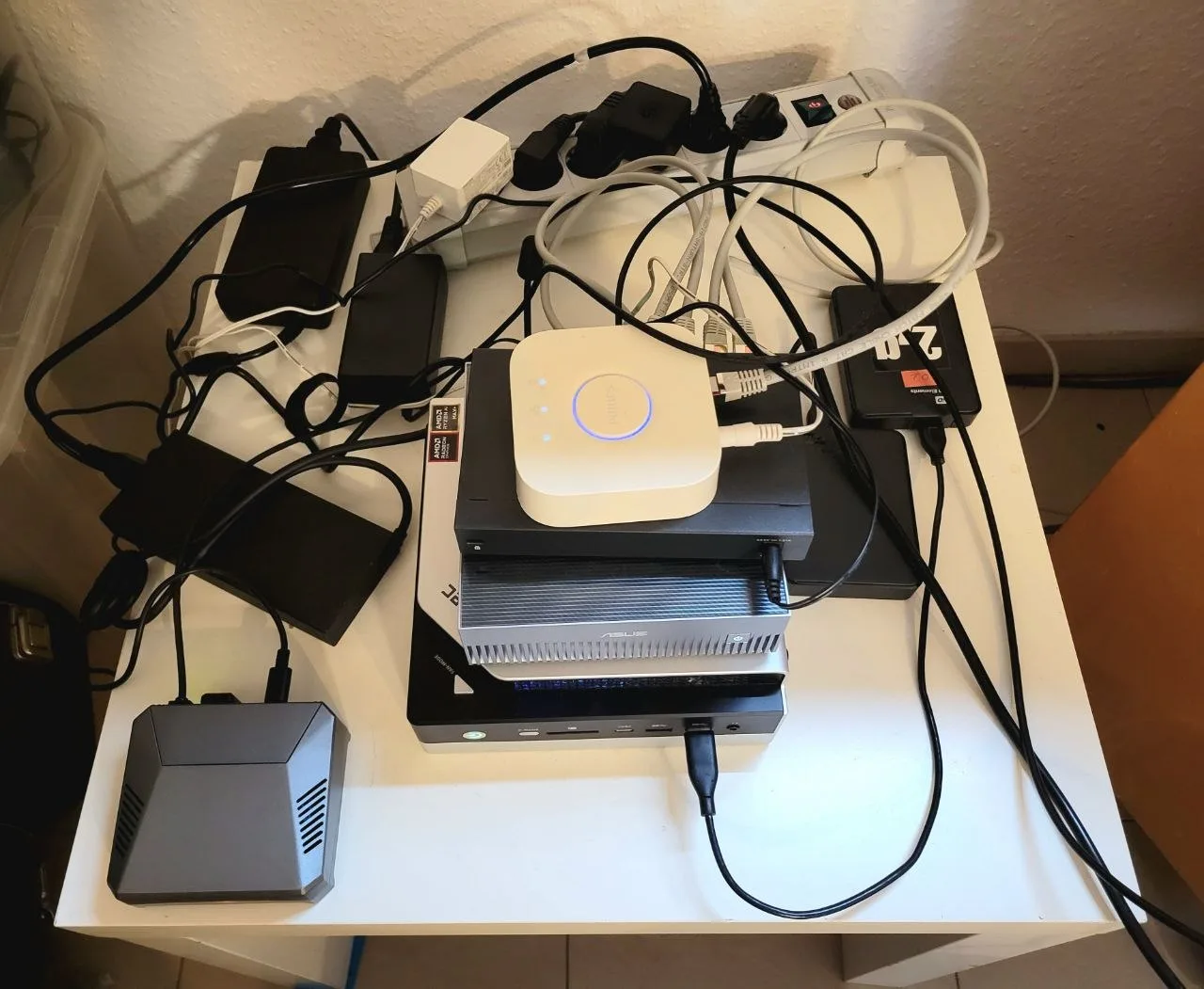
Two machines in my home lab, the denkfabrik, both provisioned from YAML with one command (that part is the kwisatz story):
- The AMD Strix Halo is the lab's core machine. Besides its own llama-swap it holds the storage and backup drives and runs the software stack a company would otherwise rent: Forgejo for code, Open WebUI, Planka for tasks, Prometheus and Grafana, Omnigent, and a Hermes AI agent I talk to over Telegram.
- The NVIDIA DGX Spark is the inference box: llama-swap as a systemd service, Prometheus and Grafana next to it, and nothing else competing for its 128 GB.
The lab exists for the same reason this post does. I wanted to know whether a small company can run its own AI and its own tools without a hyperscaler in the data path, and I'd rather find out on my own workflows and data than on a customer's.
| Component | What it does |
|---|---|
| Coding agent, Open WebUI, coworkers and family | All of them ask the same OpenAI-compatible endpoint. |
| llama-swap (proxy, port 9292) | Decides per request which engine answers, and hot-swaps models while running. |
| llama.cpp | The portable GGUF engine — runs on either box. |
| TensorFold (DGX Spark), Gufo (Strix Halo) | The hardware-specific engine setups. |
| 128 GB unified memory | Every engine shares the same memory; the weights live on disk. |
| Prometheus + Grafana | Scrapes the engines. |
The point of the inference setup is a proxy that hot-swaps models, so I can test five of them in an afternoon without logging in anywhere.
The tuned recipes are now in kwisatz too. One task per box installs Qwen3.8-27B and Qwen3.8 Flash Next (125B total, 5B active — read the active parameters) on the engine that suits the box: TensorFold on the DGX Spark, Gufo on the Strix Halo. Each task comes with its speculative-decoding draft, a pinned engine image and the llama-swap entry. Another task guards against exactly the unified-memory freeze from the traps above. The model name in the request decides which engine answers.
Nothing about this is exotic any more. It's a folder of weights, an engine, a proxy, a UI, and a dashboard.
The limits, stated plainly
Every argument above for owning the stack has a flip side: you also own its ceiling and its chores.
- The ceiling is lower. The frontier is still closed. Long-horizon reasoning, complex agentic work, and the very best multimodality live on the other side of the line. If your work depends on that, use the API — I still do, for a small slice of mine.
- Scale is your problem. One user at 50 tok/s is trivial, and a handful of parallel agents runs fine on my boxes. Fifty users is an entirely different problem, and one box doesn't solve it.
- Security is your problem. 2026's security advisories hit Ollama, vLLM and llama.cpp. Researchers counted 175,108 exposed Ollama hosts on the public internet. A local model with no auth, no firewall and no update process is not "private AI", it's a leak with a better story.
- The model is your problem. Not just the GPU: quantisation degradation, eval regressions after a checkpoint swap, KV-cache behaviour. That work is on you now, and it's genuinely work.
None of this is a reason to stay away. It's the job description — and the reason the plan below starts with the API.
What I'd do with this on a company budget
The pattern that has held up for me:
- Start with the API. Get the workflow right first. If you don't know which prompts are load-bearing, buying hardware is buying a very expensive education.
- Identify the three workloads where data cannot leave — contracts, HR, support tickets, anything under secrecy or a professional privilege. Those are your local candidates. Not "AI in general". Three specific workflows.
- Measure tokens per day. Then look up the break-even number again, because yours won't match mine, and if you're below it, the answer is a hybrid.
- Run the hybrid. Frontier API for the hard open-ended work; a pinned open-weight model behind your own endpoint for the data-sensitive, high-volume, repeatable work. Same OpenAI-compatible URL shape, one config change to move between them — that's the practical value of the standard API, and it's why this architecture is cheap to experiment with.
- Pin and document the model version. If your compliance narrative changes every time a vendor edits a web console, you don't have a compliance narrative.
We need open weights models because they're the only version of AI where the failure modes belong to me rather than to someone else's roadmap. That's not an ideological position; it's the reason I can sign off on a system that runs my customers' documents.
The weights are on the internet. The hardware is $3k and $5k. The software is mature. The only thing still scarce is someone who can wire it together — and that's rather the point of what we do.
Next up on this blog: how I work with agents day to day, and which tools I use to run the business and for my software development workflows.
Sources & further reading
| Claim | Source |
|---|---|
| 5 open-weight releases in 3 days (Oct 13–16) | AIToolCrunch, Oct 2026 |
| Muse Spark Open (816B/42B), Oct 15 | Meta AI Research |
| Mistral Large 4, 1T/52B active | Mistral |
| Open-weight landscape Apr–Oct 2026, Kolibri, Gemma 4, Qwen3.8-27B | Victor Grösser |
| DGX Spark vs Strix Halo, measured | LLMRequirements |
| Unified memory / bandwidth, 128 GB boxes | CanRun |
| vLLM vs llama.cpp vs Ollama trade-offs | Red Hat Developers, Slash-Digital |
| Break-even vs managed API | optinest, Helmcode, arXiv 2509.18101 |
| Utilisation, idle hours | francisokafor.com |
| Why open weights matter (policy) | Brookings, Microsoft, Futurium (EU) |
| EU AI Act / GDPR and self-hosting | Mickai, LLM Configurator, Lotus Libre |
| Intelligence Index v4.3.2 scores (retrieved Oct 21, 2026) | Artificial Analysis |
| Routing economics, 5+ models per enterprise | HBS Institute, Aug 2026 |
Checkout kwisatz and get weeks of research and integration work as out of the box experience. Feel free to contact us and give us feedback.